
Best Vacation Rental Operations Software
Comparent ·
Running a vacation rental business without proper software creates operational chaos across multiple platforms, guest communications, and financial tracking. The scattered spreadsheet approach costs time, money, and prevents business scaling.
The best vacation rental operations software combines property management, automated guest communication, and operational coordination into integrated platforms. Based on the 2025 Comparent Ultimate Tech Stack Survey of 624 vacation rental companies, operations management adoption remains relatively low at 26.5%, indicating significant opportunities for competitive advantage.
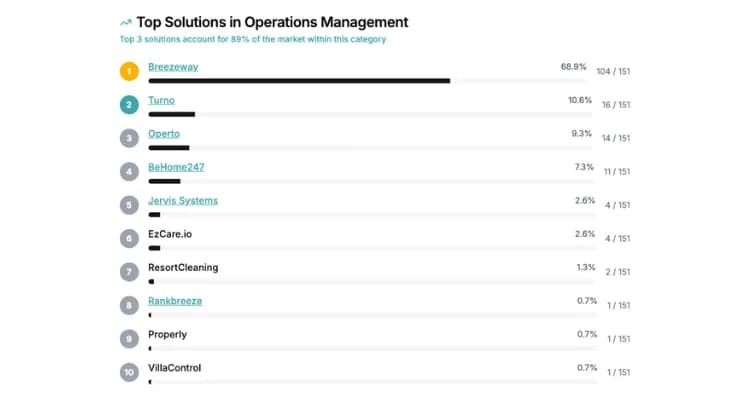
The survey reveals that only 154 companies use dedicated operations management tools, with Breezeway leading at 105 users (68.2% of operations management adopters). This low overall adoption means 73.5% of operators handle cleaning, maintenance, and turnover coordination manually.
Understanding which platforms provide genuine operational value versus marketing claims becomes crucial for strategic investment in business automation and efficiency improvements.
Key Takeaways
- Only 26.5% of vacation rental operators use dedicated operations management software, creating competitive opportunities
- Breezeway dominates operations management with 68.2% market share among adopters, followed by Turno and Operto
- Operations software adoption correlates with business sophistication and larger property portfolios
- Essential features include cleaning coordination, maintenance tracking, and guest communication automation
Operations Management Market Reality
The 2025 Comparent survey reveals a significant gap in operations management adoption, with most vacation rental operators handling coordination manually despite universal technology adoption in other categories.
Current Adoption Patterns
Only 154 out of 581 surveyed companies (26.5%) use specialized operations management tools, indicating that 427 companies (73.5%) rely on manual coordination for cleaning, maintenance, and turnovers.
Operations management leaders by actual usage:
- Breezeway: 105 companies (68.2% of operations users, 18.1% of all operators)
- Turno: 18 companies (11.7% of operations users, 3.1% of all operators)
- Operto: 14 companies (9.1% of operations users, 2.4% of all operators)
This concentration pattern shows Breezeway's dominant position among adopters, while the low overall adoption rate indicates most operators haven't found sufficient value in specialized operations tools.
Technology Sophistication Correlation
Operations management adoption correlates strongly with overall technology sophistication. Companies using operations tools typically also adopt:
Complementary technologies among operations users:
- Revenue management systems (near 100% vs 91.9% overall)
- Market data platforms (higher than 32.9% overall adoption)
- Channel management tools (above 34.7% overall adoption)
This correlation suggests that operations management becomes valuable as businesses reach sufficient complexity and sophistication to benefit from systematic coordination approaches.
Manual Operations Reality
The 73.5% of operators managing without specialized tools face significant coordination challenges:
Manual coordination requirements:
- Cleaning schedule coordination across multiple properties
- Maintenance request tracking and vendor management
- Guest turnover timing and quality control
- Supply inventory and restocking management
The gap between universal PMS adoption (100%) and operations management adoption (26.5%) indicates that most operators rely on basic PMS features or manual processes for operational coordination.
Essential Operations Software Features
Based on the survey's technology adoption patterns, successful operations software must integrate with universally adopted systems while providing specialized functionality that justifies additional investment.
Integration with Universal Technologies
Operations software must coordinate seamlessly with technologies that have achieved high adoption rates:
Property Management System Integration (100% adoption): Operations tools must sync with PMS platforms like Hostfully (25.6% share), Guesty (19.8% share), and Track (15.3% share) to access booking and guest data.
OTA Platform Coordination: With Airbnb (94.8%), Vrbo (88.6%), and Booking.com (65.2%) adoption, operations software needs access to booking timelines and guest communication requirements across all major platforms.
Revenue Management Coordination (91.9% adoption): Operations timing must align with dynamic pricing strategies from PriceLabs (42.1% share), Wheelhouse (16.5% share), and Beyond (12.9% share).
Cleaning and Maintenance Coordination
Automated task creation based on booking events eliminates manual scheduling across properties. The system should generate cleaning tasks immediately upon checkout and coordinate timing with next guest arrivals.
Quality control workflows ensure consistent property standards through photo requirements, inspection checklists, and manager approval processes before marking properties ready.
Vendor management streamlines contractor coordination through preferred vendor lists, automatic work order generation, and completion tracking across multiple properties.
Maintenance tracking prevents small issues from becoming major problems through scheduled inspections, repair history tracking, and preventive maintenance scheduling.
Guest Experience Integration
Operations coordination directly impacts guest satisfaction through:
Turnover timing optimization ensures properties are fully prepared before guest arrivals, preventing delays or quality issues that affect reviews.
Communication coordination with guest messaging systems ensures cleaning completion updates sync with check-in instruction timing.
Issue resolution tracking enables rapid response to guest-reported problems during stays, maintaining satisfaction and review ratings.
Leading Operations Management Platforms
Based on the 2025 Comparent survey data, these platforms represent the most widely adopted operations management solutions among professional vacation rental operators.
Breezeway - Market Leader
Breezeway dominates the operations management category with 105 companies using the platform, representing 68.2% of all operations management users and 18.1% of all surveyed vacation rental operators.
Market Position:
- Clear market leadership with dominant share among adopters
- Used by nearly one-fifth of all surveyed companies
- Strong satisfaction indicated by market concentration
Key Capabilities:
- End-to-end cleaning and maintenance workflow automation
- Quality control through photo requirements and inspections
- Vendor management and coordination tools
- Integration with major PMS platforms for booking data access
Breezeway's market leadership suggests it has successfully addressed the core operational coordination needs that justify adoption among the minority of operators using specialized tools.
Turno - Secondary Position
Turno holds 18 companies (11.7% of operations users), establishing it as the second-most adopted operations management platform despite significantly smaller market share than Breezeway.
Market Position:
- Clear #2 position among operations management adopters
- 3.1% of all surveyed operators use the platform
- Specialized focus serving specific operational needs
The platform's position suggests it provides differentiated features or serves specific market segments that complement rather than directly compete with Breezeway's broader market approach.
Operto - Multi-Category Platform
Operto appears across multiple survey categories, indicating a comprehensive platform approach:
Cross-category presence:
- Operations management: 14 companies (9.1% of operations users)
- Guest screening: 8 companies (47.1% of screening users)
- Digital guidebooks: 14 companies (20.6% of guidebook users)
- Guest communications: 14 companies (10.9% of communication users)
This multi-category approach suggests Operto provides integrated solutions across various operational areas rather than specialized operations management focus.
Market Concentration Analysis
The operations management category shows extreme concentration among adopters:
Top three platforms control 89.0% of adopters:
- Breezeway: 68.2%
- Turno: 11.7%
- Operto: 9.1%
This concentration pattern, combined with low overall adoption (26.5%), suggests that operations management tools serve specific business needs rather than universal operational requirements.
Integration Requirements and Technology Stack
The survey data reveals critical integration requirements for operations management tools to provide value within existing technology ecosystems.
PMS Integration Necessity
With 100% PMS adoption, operations management tools must integrate seamlessly with leading property management systems:
Required PMS integrations:
- Hostfully (25.6% market share)
- Guesty (19.8% market share)
- Track (15.3% market share)
- Streamline (9.3% market share)
Operations software needs real-time access to booking schedules, guest information, and property details to coordinate cleaning and maintenance timing effectively.
Revenue Management Coordination
The 91.9% adoption of revenue management creates coordination requirements:
Pricing strategy integration: Operations scheduling must account for dynamic pricing periods and optimal booking windows to avoid disrupting revenue optimization.
Market data coordination: Operations efficiency should align with demand forecasting and market condition analysis for optimal property preparation timing.
Channel Management Synchronization
While only 34.7% use dedicated channel management, operations tools must coordinate with multi-platform distribution:
Multi-platform coordination: Operations scheduling must account for bookings across Airbnb (94.8%), Vrbo (88.6%), and Booking.com (65.2%) with different check-in/checkout timing requirements.
Availability management: Cleaning and maintenance windows must sync with inventory availability across all booking channels to prevent scheduling conflicts.
Communication System Integration
Guest communication adoption (22.2%) requires operations coordination:
Message timing coordination: Operations completion must trigger guest communication updates for check-in instruction delivery.
Issue escalation: Operations teams need integration with guest communication systems for rapid response to guest-reported problems.
The survey's correlation patterns suggest that operations management tools become valuable as part of integrated technology ecosystems rather than standalone solutions.
Strategic Implementation Considerations
The 26.5% adoption rate for operations management indicates these tools serve specific business needs rather than universal requirements, making strategic evaluation crucial for ROI optimization.
Adoption Threshold Analysis
Operations management adoption likely correlates with business complexity thresholds:
Portfolio size requirements: The correlation with technology sophistication suggests operations tools become valuable beyond certain property counts where manual coordination becomes unsustainable.
Operational complexity: Multi-platform distribution (100% OTA adoption) combined with dynamic pricing (91.9% adoption) creates coordination complexity that may trigger operations management needs.
Quality control requirements: Properties targeting premium market segments or maintaining high review standards may require systematic operations management approaches.
Cost-Benefit Evaluation
The 73.5% non-adoption rate suggests cost-benefit analysis must justify operations management investment:
Manual coordination costs: Time spent on cleaning scheduling, maintenance coordination, and quality control across multiple properties.
Error prevention value: Operational mistakes that affect guest experience, reviews, or booking availability create quantifiable costs that operations software may prevent.
Scaling requirements: Operations management may become necessary for portfolio expansion beyond manual coordination capabilities.
Integration Investment Strategy
The survey's technology correlation patterns suggest operations management works best as part of comprehensive technology strategies:
Foundation technologies first: Ensure optimal performance from PMS (100% adoption), revenue management (91.9%), and OTA integration before adding operations management.
Complementary technology coordination: Operations management provides maximum value when integrated with channel management (34.7% adoption) and market data platforms (32.9% adoption).
Growth planning: Operations management investment should align with business scaling plans and technology ecosystem development rather than isolated efficiency improvements.
The survey data indicates that operations management tools serve as enabling technologies for sophisticated vacation rental operations rather than universal requirements for all operators.
Future Market Development
Based on the 2025 Comparent survey findings, operations management shows significant growth potential with only 26.5% current adoption among vacation rental operators.
Growth Opportunity Analysis
The low adoption rate combined with universal adoption of complementary technologies creates substantial market expansion potential:
Market size opportunity: 73.5% of operators currently manage operations manually, representing significant automation potential as businesses scale and mature.
Technology sophistication progression: The correlation between operations management and other advanced tools suggests adoption will increase as overall industry technology sophistication develops.
Competitive pressure drivers: Operators using operations management tools may achieve efficiency advantages that eventually force broader market adoption, similar to revenue management evolution (91.9% adoption).
Platform Consolidation Trends
Breezeway's market dominance (68.2%) positions it for continued growth, particularly if it expands integration capabilities with leading PMS platforms and revenue management tools.
Multi-category platforms like Operto may capture market share through comprehensive solutions that address multiple operational areas rather than specialized operations management.
Integration-focused solutions that coordinate seamlessly with universally adopted technologies (PMS, revenue management, OTAs) may capture operators seeking consolidated technology ecosystems.
Technology Integration Evolution
PMS platform expansion: Leading PMS providers (Hostfully, Guesty, Track) may develop internal operations management capabilities to provide comprehensive solutions rather than requiring separate operations tools.
Revenue management coordination: The correlation between operations management and revenue optimization suggests future integration for holistic property performance management.
AI and automation advancement: Technology improvements may reduce operations management complexity and cost barriers, enabling broader adoption among smaller operators currently using manual processes.
The survey data suggests that operations management will evolve from specialized tools serving sophisticated operators to broader market infrastructure as technology costs decrease and integration capabilities improve.
Frequently Asked Questions
Understanding vacation rental operations software requires knowing which platforms provide genuine value, how adoption patterns vary by business complexity, and which features justify investment over manual coordination approaches.
Which operations management platforms are most widely adopted by vacation rental operators?
Based on the 2025 Comparent Ultimate Tech Stack Survey of 624 vacation rental companies, Breezeway leads with 105 users, representing 68.2% of all operations management adopters.
Turno ranks second with 18 users (11.7% of operations adopters), while Operto captures 14 users (9.1% of adopters). However, only 154 total companies (26.5%) use any specialized operations management software.
This means 427 companies (73.5%) handle cleaning, maintenance, and operational coordination manually or through basic PMS features rather than dedicated operations tools.
The low overall adoption rate indicates that operations management tools serve specific business needs rather than universal operational requirements among vacation rental operators.
How does operations management software adoption correlate with other vacation rental technologies?
The survey reveals strong correlations between operations management usage and overall technology sophistication:
Companies using operations management tools show significantly higher adoption rates of revenue management systems (near 100% vs 91.9% overall), market data platforms (above 32.9% overall), and channel management solutions (above 34.7% overall).
This correlation suggests that operations management becomes valuable as businesses reach sufficient complexity through multi-platform distribution, dynamic pricing strategies, and comprehensive property management approaches.
The technology adoption patterns indicate that operations management works best as part of integrated technology ecosystems rather than standalone efficiency improvements.
What are the main benefits of using specialized operations management software?
Operations management software provides systematic coordination of cleaning, maintenance, and guest turnover processes that become difficult to manage manually as businesses scale.
Key benefits include automated task creation based on booking events, quality control workflows through photo requirements and inspections, and vendor management coordination across multiple properties.
The 73.5% of operators managing manually face time-intensive coordination challenges that operations software can automate, particularly for larger portfolios or complex operational requirements.
However, the low adoption rate (26.5%) suggests that these benefits may not justify the investment for all operators, particularly those with smaller portfolios or simpler operational needs.
Are there cost-effective operations management solutions for smaller vacation rental businesses?
The survey data shows extreme market concentration with Breezeway dominating 68.2% of adopters, followed by much smaller platforms like Turno (11.7%) and Operto (9.1%).
This concentration pattern, combined with low overall adoption (26.5%), suggests that existing solutions may be designed for larger or more complex operations rather than smaller businesses.
The 73.5% non-adoption rate indicates that most operators find manual coordination approaches sufficient for their current business complexity and portfolio size.
Smaller operators should evaluate whether their operational complexity justifies specialized software investment versus improving manual coordination processes or using basic PMS operational features.
How do I determine if my vacation rental business needs operations management software?
The survey data suggests operations management tools become valuable based on business complexity thresholds rather than universal requirements:
Evaluate your current manual coordination time investment across cleaning scheduling, maintenance tracking, quality control, and vendor management for multiple properties.
Consider whether operational mistakes (missed cleanings, maintenance delays, quality issues) create quantifiable costs through guest dissatisfaction, review impacts, or booking disruptions.
Assess your technology sophistication level - operations management typically provides value for businesses already using revenue management (91.9% adoption), market data platforms (32.9% adoption), and comprehensive PMS solutions (100% adoption).
The correlation patterns suggest that operations management works best for businesses that have already optimized their foundation technologies and need systematic coordination for scaling beyond manual management capabilities.