
Best Vacation Rental Channel Manager
Comparent ·
Managing multiple vacation rental listings across platforms like Airbnb, Vrbo, and Booking.com creates operational complexity, but based on the 2025 Comparent Ultimate Tech Stack Survey of 624 vacation rental companies, most operators handle this coordination without dedicated channel management tools.
Only 191 out of 539 companies (34.7%) use dedicated channel management software, while 348 companies (65.3%) reported using no specialized channel management solution. This means nearly two-thirds of vacation rental operators manage multi-platform distribution manually or through basic PMS integrations.
Among the minority using dedicated tools, TrackDistribution leads with 61 companies (11.4% of all operators), followed by BookingPal with 51 companies (9.5%) and Rentals United with 42 companies (7.9%). The low overall adoption suggests that manual coordination remains viable for most operators' current business scale and complexity.
Understanding this adoption reality helps operators evaluate whether channel management tools provide sufficient value to justify investment over existing manual processes or basic integrations.
Key Takeaways
- Only 34.7% of vacation rental operators use dedicated channel management software
- TrackDistribution leads with 11.4% of all operators, followed by BookingPal (9.5%) and Rentals United (7.9%)
- The 65.3% managing without specialized tools suggests manual coordination meets most operators' needs
- Channel management adoption correlates with business sophistication and larger property portfolios
Channel Management Market Reality
The 2025 Comparent survey reveals channel management as a moderately adopted technology category, with most vacation rental operators successfully managing multi-platform distribution without specialized tools.
Current Adoption Patterns
539 companies reported on channel management usage, with only 191 companies (34.7%) using dedicated solutions and 348 companies (65.3%) reporting no specialized channel management tools.
Channel management leaders by actual usage:
- TrackDistribution: 61 companies (11.4% of all operators, 32.8% of channel management users)
- BookingPal: 51 companies (9.5% of all operators, 27.4% of channel management users)
- Rentals United: 42 companies (7.9% of all operators, 22.6% of channel management users)
- NextPax: 31 companies (5.8% of all operators, 16.7% of channel management users)
The market shows moderate concentration with the top three providers serving 82.8% of channel management users, though overall adoption remains limited.
Manual Coordination Reality
The 65.3% of operators managing without dedicated channel management tools rely on alternative approaches:
Property Management System integrations: With 100% PMS adoption, most operators likely use built-in channel coordination features from platforms like Hostfully (25.6% share), Guesty (19.8% share), and Track (15.3% share).
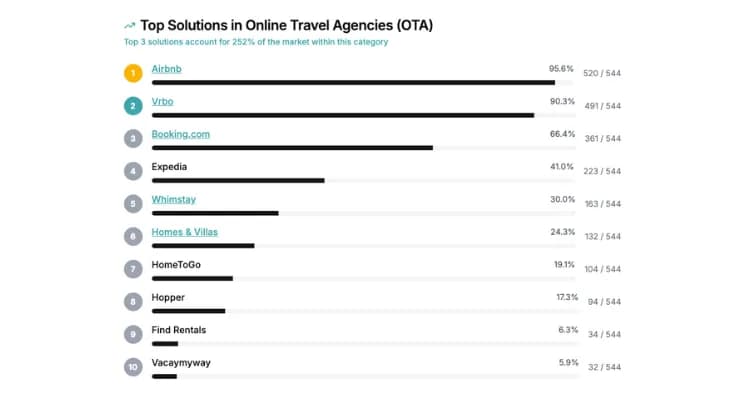
Platform-native tools: Direct management through Airbnb (94.8% adoption), Vrbo (88.6% adoption), and Booking.com (65.2% adoption) native calendars and pricing tools.
Manual coordination: Daily updates across platforms, accepting the time investment to avoid additional software complexity and costs.
This high non-adoption rate suggests that existing coordination methods meet operational needs for most business scales and property portfolios.
Correlation with Business Sophistication
Channel management adoption likely correlates with overall technology sophistication. Companies using channel management tools typically also demonstrate higher adoption of:
Advanced operational tools: Higher usage of operations management (26.5% overall adoption), market data platforms (32.9% adoption), and revenue management systems (91.9% adoption).
Larger portfolios: Channel management becomes more valuable as operators scale beyond manual coordination capabilities, typically around 10-20+ properties.
Multi-market operations: Operators managing properties across different geographic markets may require systematic distribution coordination.
The correlation patterns suggest channel management serves scaling businesses rather than universal operational requirements.
Leading Channel Management Platforms
Based on the Comparent survey data, these platforms represent the most widely adopted channel management solutions among vacation rental operators.
TrackDistribution - Market Leader
TrackDistribution leads channel management adoption with 61 companies using the platform, representing 11.4% of all surveyed operators and 32.8% of channel management users.
Market Position:
- Clear market leadership in channel management category
- Connection to Track PMS (15.3% market share) suggesting integrated ecosystem
- Strong adoption indicating proven value for multi-platform coordination
TrackDistribution's leadership position suggests effective integration with vacation rental operational workflows and successful value delivery for operators requiring systematic channel coordination.
BookingPal - Strong Secondary
BookingPal holds 51 companies (9.5% of all operators), establishing a competitive secondary position with significant market presence among channel management adopters.
Market Position:
- Solid #2 position with 27.4% of channel management users
- Independent platform serving diverse PMS integrations
- Proven track record with established operator base
BookingPal's position indicates successful specialization in channel management with competitive features and integration capabilities.
Rentals United - Third Position
Rentals United captures 42 companies (7.9% of all operators), representing the third-largest adoption among channel management solutions.
Market Position:
- Notable market presence with 22.6% of channel management users
- Focus on international and European market distribution
- Specialized approach to global channel coordination
Rentals United's position suggests successful specialization in international market distribution and multi-regional channel management.
NextPax - Emerging Platform
NextPax serves 31 companies (5.8% of all operators), representing 16.7% of channel management users and indicating emerging market presence.
Market Position:
- Growing platform with notable adoption
- Focus on automation and streamlined channel coordination
- Competitive positioning in developing market segment
NextPax's presence indicates continued market development and competition within the channel management category.
Market Concentration Analysis
The channel management category shows moderate concentration among adopters:
Top four platforms serve 93.2% of channel management users, indicating strong market consolidation among the minority who adopt specialized tools.
However, the overall low adoption (34.7%) suggests that channel management remains specialized rather than universal operational infrastructure.
Essential Channel Management Features
Given the low adoption rates, successful channel management platforms must provide exceptional value to justify investment over manual coordination or basic PMS integrations.
Integration with Universal Technologies
Channel management tools must coordinate seamlessly with universally adopted vacation rental technologies:
Property Management System Integration (100% adoption): Channel managers must sync effectively with leading PMS platforms like Hostfully (25.6%), Guesty (19.8%), and Track (15.3%) to access booking data and property information.
OTA Platform Connections: Direct integrations with Airbnb (94.8%), Vrbo (88.6%), and Booking.com (65.2%) are essential for effective multi-platform coordination.
Revenue Management Coordination (91.9% adoption): Channel management must support dynamic pricing strategies from PriceLabs (42.1% share), Wheelhouse (16.5% share), and Beyond (12.9% share).
Core Channel Coordination Features
Real-time calendar synchronization prevents double bookings across all connected platforms through instant availability updates when reservations are confirmed.
Rate and pricing distribution ensures consistent pricing strategies across all channels while supporting platform-specific pricing rules and restrictions.
Content management maintains consistent property descriptions, photos, and amenities across all distribution channels without manual updates.
Booking consolidation provides unified visibility into reservations from all channels through centralized dashboards and reporting.
Operational Integration Requirements
Guest communication coordination ensures seamless messaging workflows across multiple booking platforms without platform-switching requirements.
Financial reporting consolidation tracks performance and commission costs across all channels for comprehensive revenue analysis.
Operations coordination aligns channel management with cleaning schedules, maintenance windows, and guest turnover requirements.
The survey data suggests that successful channel management platforms must provide comprehensive operational benefits rather than simple calendar synchronization to justify adoption over existing coordination methods.
Strategic Implementation Considerations
The 34.7% adoption rate for channel management indicates these tools serve specific scaling requirements rather than universal operational needs, making strategic evaluation crucial.
Adoption Threshold Analysis
Channel management becomes valuable beyond certain business complexity thresholds:
Portfolio size considerations: Manual coordination becomes unsustainable as operators scale beyond 10-15 properties across multiple platforms.
Platform diversity requirements: Operators using multiple OTAs beyond the standard Airbnb-Vrbo-Booking.com combination may require systematic coordination tools.
Operational sophistication: The correlation with advanced technology adoption suggests channel management serves operators with comprehensive business systems.
Cost-Benefit Evaluation
The 65.3% non-adoption rate suggests careful cost-benefit analysis is essential:
Time savings quantification: Calculate hours spent on manual platform coordination across properties and platforms to determine if channel management fees provide positive ROI.
Error prevention value: Assess costs of double bookings, rate inconsistencies, and coordination mistakes that channel management could prevent.
Revenue optimization potential: Evaluate whether systematic channel management enables revenue improvements through better distribution and pricing coordination.
Scaling requirements: Determine if business growth plans justify channel management investment for future operational efficiency.
Integration Strategy
Channel management works best as part of comprehensive technology strategies:
Foundation technology optimization: Ensure PMS (100% adoption) and revenue management (91.9% adoption) perform effectively before adding channel management complexity.
Complementary technology coordination: Channel management provides enhanced value when integrated with operations management (26.5% adoption) and market data platforms (32.9% adoption).
Business scaling alignment: Channel management investment should align with growth plans requiring systematic multi-platform coordination rather than current-state optimization alone.
The survey data indicates that channel management tools serve enabling functions for scaling vacation rental operations rather than universal operational requirements.
Future Market Development
The 34.7% adoption rate and moderate market concentration suggest channel management will remain a specialized solution serving scaling businesses rather than achieving universal adoption.
Growth Opportunity Analysis
Market expansion potential: 65.3% of operators currently manage channels manually, representing potential automation opportunity as businesses scale and operational complexity increases.
Technology integration improvement: Better integration with leading PMS platforms and operational systems may increase value propositions and reduce implementation barriers.
Scaling requirement drivers: Operators expanding beyond manual coordination capabilities will increasingly require systematic channel management solutions.
Platform Development Trends
PMS integration enhancement: Leading PMS providers may develop enhanced internal channel management capabilities, potentially reducing demand for specialized channel management tools.
Comprehensive solution development: Channel management platforms may expand into broader vacation rental management capabilities to provide integrated rather than specialized solutions.
Automation advancement: Technology improvements may reduce manual coordination burden, potentially extending the viability of non-specialized approaches.
Market Consolidation Potential
Current concentration patterns (top four serve 93.2% of adopters) suggest mature market structure among adopters, with limited opportunity for new platform development.
Integration-focused competition: Future success may depend on integration quality with leading PMS and operational platforms rather than standalone channel management features.
Comprehensive platform evolution: Channel management may become integrated features within broader vacation rental management ecosystems rather than specialized solutions.
The survey data suggests that channel management will continue serving scaling businesses and sophisticated operations rather than achieving the universal adoption seen in PMS (100%) or revenue management (91.9%) technologies.
Frequently Asked Questions
Understanding vacation rental channel management requires recognizing the moderate adoption patterns and evaluating whether specialized tools provide sufficient value over existing coordination approaches.
How widely do vacation rental operators adopt channel management software?
Based on the 2025 Comparent Ultimate Tech Stack Survey of 624 vacation rental companies, only 191 out of 539 operators (34.7%) use dedicated channel management software.
This means 348 companies (65.3%) manage multi-platform distribution without specialized channel management tools, relying instead on manual coordination, PMS integrations, or platform-native management.
Among channel management users, TrackDistribution leads with 61 companies (11.4% of all operators), followed by BookingPal with 51 companies (9.5%) and Rentals United with 42 companies (7.9%).
The moderate adoption rate indicates that channel management serves specific scaling requirements rather than universal operational needs.
What are the leading channel management platforms based on actual usage?
The survey reveals TrackDistribution as the most widely adopted platform with 32.8% of channel management users, followed by BookingPal at 27.4% and Rentals United at 22.6%.
NextPax holds 16.7% of the channel management market, with the top four platforms serving 93.2% of all channel management users.
However, these platforms serve only a subset of the total market, as 65.3% of operators use no specialized channel management tools.
The market concentration among adopters contrasts with the limited overall adoption, indicating channel management serves specialized rather than universal needs.
Why do most vacation rental operators choose not to use dedicated channel management tools?
The 65.3% non-adoption rate suggests several factors influence channel management decisions:
Many operators successfully manage multi-platform distribution through PMS integrations (100% PMS adoption) or platform-native tools without requiring additional specialized software.
Manual coordination may provide sufficient control and cost-effectiveness for smaller portfolios or operators comfortable with daily platform management routines.
Cost-benefit analysis may not justify channel management expenses for operators with limited property counts or simple distribution strategies.
Integration complexity and learning curves may deter operators who prefer streamlined technology approaches focused on core PMS and revenue management systems.
How does channel management adoption correlate with other vacation rental technologies?
The survey shows channel management adoption correlating with overall technology sophistication, though specific correlation data isn't provided.
Operators using channel management likely demonstrate higher adoption of advanced technologies like operations management (26.5% overall adoption), market data platforms (32.9% adoption), and comprehensive business systems.
Channel management becomes more valuable as businesses scale beyond manual coordination capabilities and require systematic multi-platform distribution management.
The technology adoption patterns suggest channel management serves as an enabling tool for sophisticated operations rather than standalone efficiency improvement.
What should operators consider when evaluating channel management investment?
Operators should assess their current coordination time investment, error rates, and scaling requirements to determine if channel management provides positive ROI over existing approaches.
Portfolio size and platform diversity influence channel management value, with larger operations and complex distribution strategies benefiting more from systematic coordination tools.
Integration capabilities with existing PMS (100% adoption) and revenue management systems (91.9% adoption) determine implementation success and operational efficiency gains.
The 65.3% successfully managing without channel management tools suggests these solutions aren't universally necessary, making strategic evaluation crucial before investment.